Welcome to Delgado Law Firm, "La Mera Mera"
ICE Enforcement in San Antonio: What the Numbers Show About the Impact on Local Families
Immigration enforcement has become a growing concern for families across San Antonio. Since President Donald Trump returned to office, his administration has increased immigration enforcement efforts, and Immigration and Customs Enforcement (ICE) has expanded its activity across the country. San Antonio has seen a significant increase in ICE enforcement activity. This is affecting individuals, parents, spouses, children, and entire families.
Recent data shows the increased ICE detention activity in the San Antonio area.
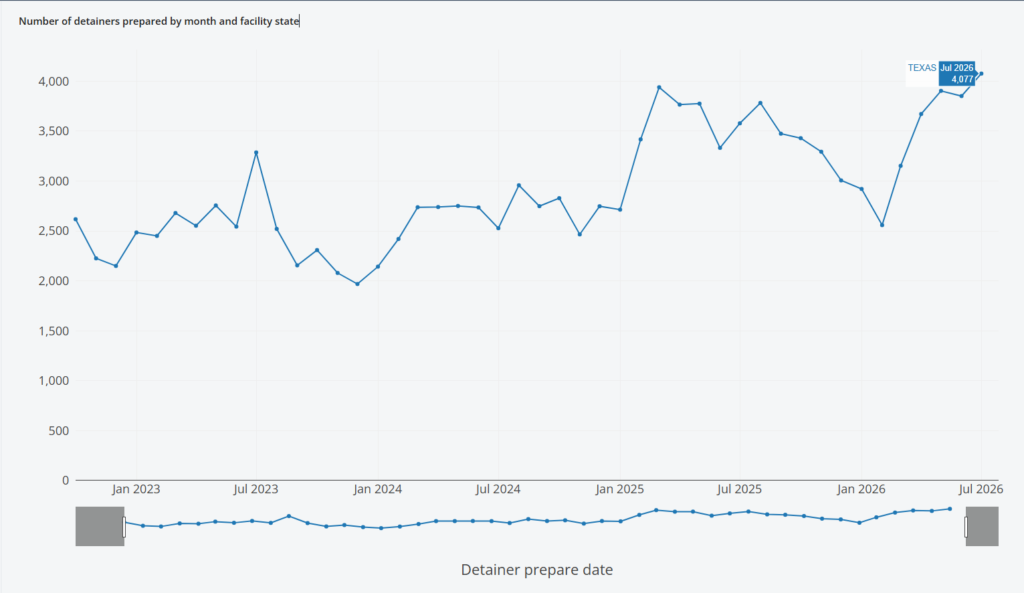
ICE Activity in San Antonio Has Reached High Levels
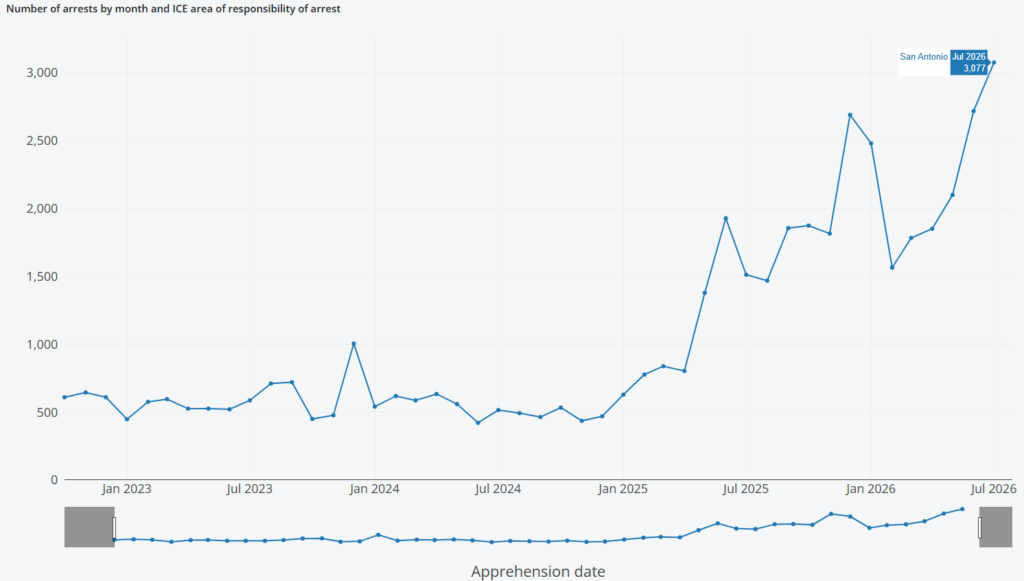
The data provided for San Antonio tracks the number of individuals booked into ICE detention each month. The chart shows significant changes in detention activity from 2023 through 2026, with enforcement reaching some its highest levels in 2026.
One of the most notable points in the data is July 2026, when the chart records 4,077 individuals. This represents a substantial level of ICE detention activity compared with many earlier months shown in the data.
The overall trend is important. While the number of individuals detained has gone up and down from month to month, the chart shows that ICE activity in the San Antonio area has generally reached much higher levels during the years 2025 and 2026 than during 2023 and 2024.
This local data is consistent with what has been reported about immigration enforcement nationally. In July 2026, ICE arrested nearly 50,000 people nationwide, the highest monthly total during President Trump’s second term at that time. Data — ICE Arrests with detentions
San Antonio Is Feeling the Impact
These numbers are not simply statistics. Every detention represents an individual whose family, employment, finances, and future may have suddenly been affected.
When a parent is detained, children may suddenly be left without a caregiver. When a spouse is detained, their partner may be left responsible for rent, mortgage payments, childcare, transportation, and other household expenses. A business owner or employee who is detained may also leave colleagues and customers wondering what will happen next.
For families with mixed immigration statuses, the consequences can be particularly serious. A family may include U.S. citizen children, lawful permanent residents, people with pending immigration applications, and family members without permanent status all living in the same household.
Recent reporting has documented the human impact of increased enforcement in the San Antonio area. One local community organization reported that many families have experienced detention or the loss of a family member through immigration enforcement since President Trump returned to office. La iglesia de los migrantes: el único refugio que encuentra una comunidad de Texas acechada por el ICE | Inmigración en Estados Unidos | EL PAÍS US
The increased enforcement is occurring through different methods, ICE activity does not always involve a highly publicized immigration raid. Recent reporting indicates that enforcement can involve arrests during traffic related encounters, at workplaces, at immigration courts, at government appointments, or through cooperation between federal immigration authorities and local law enforcement.
San Antonio Families Should Take Immigration Matters Seriously
With the level of increased enforcement shown in the San Antonio area, individuals who have unresolved immigration issues should not assume that they are safe simply because they have lived in the United States for many years.
A person may have a pending immigration application, an old immigration order, a prior arrest or criminal case, an expired immigration benefit, or another issue that could become important if they encounter immigration authorities.
At the same time, every immigration case is different. Being contacted or approached by ICE, even being detained does not automatically mean that a person has no legal options. Depending on the circumstances, an individual may have possible defenses, applications, appeals, motions, or other forms of immigration relief available.
This is why it is important for individuals and families to understand their immigration situation before an emergency occurs.
If you or a family member has an immigration case, it may be helpful to know:
› What your current immigration status is.
› Whether you have a pending application or petition.
› Whether you have ever received an immigration court notice.
› Whether you have an old removal or deportation order.
› Whether a previous arrest or criminal case could affect your immigration status.
› What documents your family should have available if someone is detained.
› Who your family should contact if ICE takes a loved one into custody.
Enforcement Numbers Can Have a Human Impact
The increase in ICE activity in San Antonio demonstrates why families should pay attention to what is happening in their own community. The July 2026 figure of 3,077 individuals shown in the provided San Antonio data is more than a number—it represents thousands of situations in which individuals and families may have faced uncertainty, separation, financial hardship, and fear.
The Trump administration’s immigration crackdown has made immigration enforcement a reality that many San Antonio families are now thinking about much more seriously. Nationally, the number of ICE arrests has continued to rise, while enforcement has increasingly reached people who may have no criminal conviction or who have pending immigration matters.
If you have an immigration case, concerned about a family member, or concerned for yourself PLEASE do not wait until there is an emergency to understand your options.
We highly suggest consulting with an experienced immigration attorney, please call our office today at (210)-294-9093 to set up a consultation with San Antonio’s #1 Immigration Attorney, Ofelia Delgado.
The information in this article is for general informational purposes only and does not constitute legal advice. Immigration laws and enforcement policies can change, and every person’s situation is different.
Desclaimer: Do not send confidential information via this site. The information, material, videos, and linked sites on this website are for general informational purposes only. Delgado Law Firm does not warrant or make any representation about the accuracy and reliability of materials, resources, and linked sites on this website. This website is not intended to provide legal advice nor does it create an attorney-client relationship. An attorney-client relationship is not formed upon using or communicating with Delgado Law Firm through this site.
© 2023 Delgado Law Firm. All Rights Reserved.